
Reports (not denied by India) that the USA had 'for the first time provided real-time details to their Indian counterparts on the Chinese positions and force strength in advance of a PLA incursion' into Tawang at the LAC in December 2022, helping India thwart China's expansionist designs, show how operationally effective the USA-India friendship has become on the ground. A engaging excerpt from Sreeram Chaulia's must-read new book, Friends: India's Closest Strategic Partners.

Emphasising the importance of sustaining food and energy security, the G20 leaders called for the "cessation of military destruction or other attacks on relevant infrastructure".

The agreement provides for extensive cooperation in the civil nuclear energy sector including in research and development for peaceful uses of nuclear energy, they said.

China, the Ukraine crisis and Quad will dominate the discussions, observes Dr Rajaram Panda.
Chief of Defence Staff General Anil Chauhan on Saturday said India's Operation Sindoor has drawn a 'new red line' of intolerance against terror, and expressed hope that the military action has brought 'some lessons for our adversary also'.
It was good fortune for India to have Atal Bihari Vajpayee lead the government at a crucial moment in our history. He avoided India meeting the fate of Iraq or Ukraine, asserts military historian Colonel Anil A Athale (retd).
Prime Minister Narendra Modi and French President Emmanuel Macron have called for enhancing trade and investment ties between their countries and committed to further deepening their engagement in the Indo-Pacific. They discussed a full spectrum of bilateral relations, including key global and regional issues, and stressed the urgent need for reform in the United Nations Security Council. The leaders also underscored their commitment to ensuring the global AI sector can drive positive social, economic, and environmental outcomes.
Former Indian Prime Minister Manmohan Singh's effusive praise of US President George W Bush during their 2008 meeting in the White House is revisited as a testament to their close relationship and the impact of the landmark Indo-US civil nuclear deal. Singh's statement, while drawing criticism from the Left and BJP, highlighted the transformative nature of the relationship between the two democracies. The article explores the context of their meeting and the broader significance of their relationship in the context of the Indo-US nuclear deal.

On June 12, history was made when United States President Donald Trump shook hands with North Korean leader Kim Jong-un and had extensive talks at Capella Hotel in Singapore. However, this meet has come after several twists and turns. Following is the chronology of key events leading to a historic summit between the two leaders.

'As one might expect, he believed the Indians were preparing their nuclear weapons for deployment. It took us a few hours - and remarkably good work by our teams on the ground in New Delhi and Islamabad - to convince each side that the other was not preparing for nuclear war'

Trump announced that India and the US agreed to work together to build the India-Middle East-Europe Economic Corridor (IMEC) and called it one of the greatest trade routes. He said that the route will operate from Israel to Italy and onward to the US.
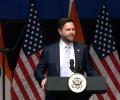
US Vice President JD Vance called on India to drop non-tariff barriers, give greater access to its markets and buy more American energy products and military hardware. Vance, in a speech in Jaipur, highlighted the need for a stronger US-India partnership for a prosperous and peaceful 21st century. He emphasized the importance of working together to address global challenges and praised Prime Minister Narendra Modi, describing him as a "special person." Vance also urged India to provide greater market access to American products and buy more defense platforms and energy from the US. He suggested that India consider dropping some of the non-tariff barriers for American access to the Indian market and highlighted the benefits of closer India-US defense collaboration, advocating for New Delhi to procure more military hardware from the US. He cited the example of American fifth-generation F-35s, arguing they would give the Indian Air Force the ability to defend its airspace and protect its people like never before. Vance also welcomed the Modi government's budget announcement to amend India's civil nuclear liability laws, paving the way for US producers to export small modular reactors and build larger US-designed reactors in India. He emphasized the importance of energy security for India's AI ambitions, stating "there is no AI future without energy security and energy dominance." Vance's visit comes amid growing global concerns over the US's tariff war.
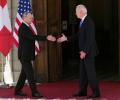
The summit probably fulfilled the expectations on both sides, but the bar of expectations was intentionally kept low, observes Ambassador M K Bhadrakumar.
The reality is that far from being friendless, India is better positioned in the world than at any point post-Cold War, asserts Shekhar Gupta.

According to Dawn, Modi in his message reiterated India's desire to build good neighbourly relations with Pakistan.
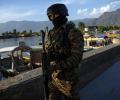
The 'mediation' by the United States from behind the scene on the diplomatic track appears to be once again working, which calls on both Delhi and Islamabad to show restraint and pull back from a military confrontation, notes Ambassador M K Bhadrakumar.

'While on the one hand, terrorism continues to be a serious threat to global peace and security, on the other hand, areas such as cyber, maritime and space, are emerging as new theatres of conflict'
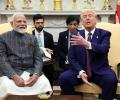
'Trump administration wanted a positive tone at this summit, but there was still some anxiety that there could be some awkward moments -- and there were not.'

With Pakistan moving towards tactical nuclear weapons, there is an increasingly higher risk of nuclear theft, a US think-tank report has warned ahead of the Nuclear Security Summit in Washington later this month.

'Trump forgets that Kim is not one who likes to be treated publicly as a pauper; he wants to come to the table as an equal, and from a position of perceived strength, not as a suppliant,' says Dr Rajaram Panda.

Posing a series of questions to the prime minister, Congress general secretary in-charge communications Jairam Ramesh also asked if Modi would convey to the US president that India would send its own aircraft -- like Venezuela and Colombia did -- to bring back Indian deportees in the future.

Prime Minister Dr Manmohan Singh [ Images ] on Sunday night Indian time met United States President Barack Obama and is understood to have discussed nuclear security, India's concerns over American military aid to Pakistan and the volatile situation in Afghanistan.

The prime minister is all set to break his record of spending most days in the country without travelling abroad.

The White House said that Obama, who has been often accused by critics of making an "apology tour" to the Middle East and Europe during the first year of his presidency.
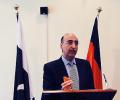
Talking to reporters in New Delhi, he described the proposed visit of a five-member investigation team of Pakistan to probe the Pathankot terror attack as a "positive development" and hoped they will be able to do their work "productively".
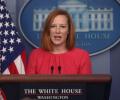
"AUKUS? What would it become? JAUKUS? JAIAUKUS?" Psaki said in lighter moments before giving answer to the question.

Modi will arrive in France on Thursday evening and straightaway head for talks with Macron, who will also host a working dinner for the visiting leader.

As a leader, he was ambitious, not for himself but for India and its people. His was not the short-term election cycle calculation of individual political gain. His was a practical vision of how to better the lives of his fellow citizens, asserts Ambassador Shivshankar Menon, who served as foreign secretary and national security advisor when Dr Singh was prime minister.
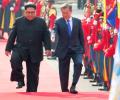
'Much depends on Moon's persuasive skill to make both Trump and Kim shed some of their rigidity and be flexible to accommodate contrarian viewpoints,' says Dr Rajaram Panda.

The announcement of date and venue comes a day after Putin's adviser Yuri Ushakov in Moscow said the two leaders will meet in a third country.

Addressing a joint media event with Macron, Modi said the two countries have robust cooperation in the fields of defence and security.
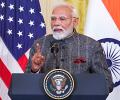
Those who stay in other countries illegally do not have any legal right to be there, Modi said.

The bilateral and Quad summits, in which Prime Minister Modi played a significant role, has sent the right message to China, observes Ambassador T P Sreenivasan.

'The touchstone is reciprocity which will be applied to friends and foes alike.' 'It will be a bitter pill to swallow.'

Prime Minister Manmohan Singh is expected to undertake a six-day visit to the United States from September 20, during which he will have a bilateral meeting with President Barack Obama in Washington besides attending the United Nations General Assembly in New York.
India and South Korea have reached an agreement on civil nuclear cooperation.

United States President Donald Trump and North Korean leader Kim Jong Un have arrived in Vietnam and are getting ready for their second meeting in just nine months. The two leaders, who have a history of insult-hurling and name-calling, plan to discuss nuclear weapons on Wednesday and Thursday in Hanoi. The meetings are a follow-up to their first summit last June, when they signed a vaguely worded agreement promising to work toward denuclearisation of the Korean Peninsula.

Russia's unprecedented rapprochement with North Korea has raised concerns about the re-emergence of a Russia-China-North Korea alliance which could increase the probability of conflict on the Korean Peninsula, explains Dr Rajaram Panda.

'Xi Jinping is keen that the second Trump-Kim summit happens soonest.' 'Kim is reported to have told Xi that he expects to achieve a result from a second summit that the international community would welcome,' points out Dr Rajaram Panda.
Canada will become the latest country with which India shall have civil nuclear deal since the Nuclear Suppliers Group (NSG) allowed New Delhi to resume global nuclear trade in September 2008.
